Complete a pattern
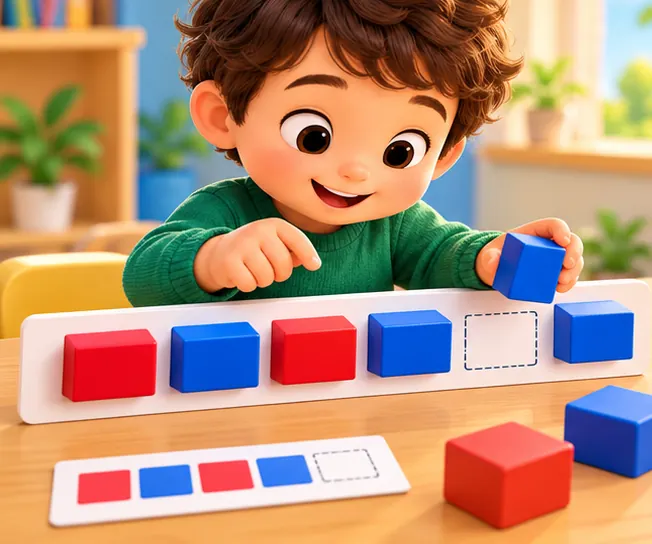
Make a repeating line such as block–spoon–block–spoon, or circle–square–circle–square. Leave one space empty and ask what may fit. Then invite the child to create a pattern for you.
Think, remember, predict and solve! 🕷️🧠
Patterns, sequencing, memory, classification and beginner logic challenges that encourage careful observation and reasoning. Follow the activities in order when you want a gradual progression, or choose one based on your child's interest today.
Open the full activity for examples, guided play, an extension challenge and a parent or educator tip.
Open activity →
Open the full activity for examples, guided play, an extension challenge and a parent or educator tip.
Open activity →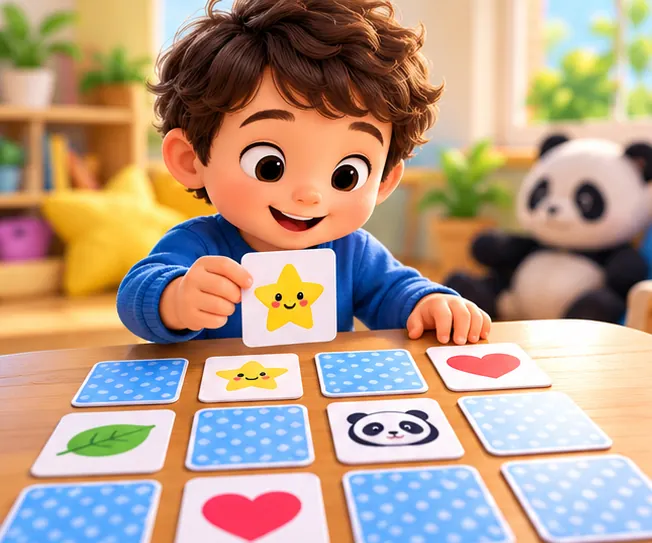
Open the full activity for examples, guided play, an extension challenge and a parent or educator tip.
Open activity →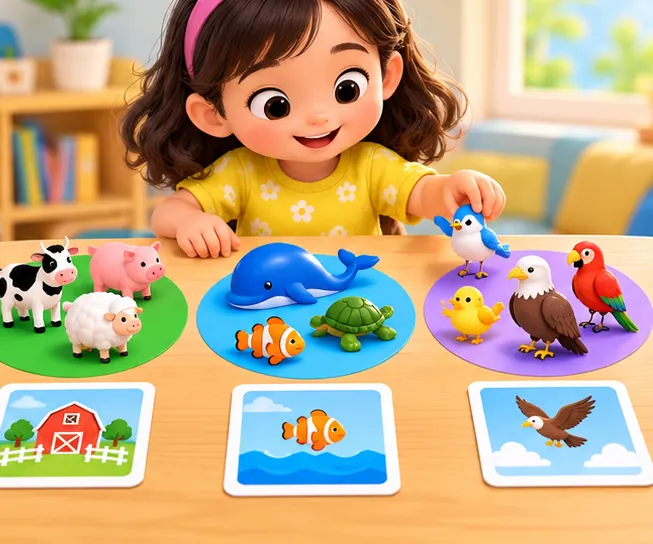
Open the full activity for examples, guided play, an extension challenge and a parent or educator tip.
Open activity →
Open the full activity for examples, guided play, an extension challenge and a parent or educator tip.
Open activity →Give children time to study a pattern or group before asking for an answer.
Ask “What do you notice?” and “What makes you think that?” rather than only asking for a result.
Treat an incorrect answer as a chance to test another possibility.
Invite the child to invent a pattern, sequence or puzzle for someone else to solve.
Short, positive practice is enough. Follow the child's attention, give them time to answer, and celebrate careful thinking and effort.
A logic activity is most useful when the child can show how they decided, even if the first answer needs changing.
Make a repeating line such as block–spoon–block–spoon, or circle–square–circle–square. Leave one space empty and ask what may fit. Then invite the child to create a pattern for you.
Place three familiar objects on a table, let the child study them, then cover them and move one object. Ask what changed. Start with fewer objects if this is frustrating.
Sort toys by type, then choose a new rule such as size or color. Ask which objects need to move and why. There may be more than one sensible rule if the child can explain it.
Try “What do you notice?”, “What made you choose that?”, “What could we test?”, and “Did the clue change your idea?” Avoid rushing to correct a response before the child has had a chance to explain.
Explore another learning path or visit a Kids4U story for a playful change of pace.
Back to Learn & Play →Complete a pattern on screen, then explore more thinking challenges. When you're ready, use the printable version below for extra practice away from the screen.
Need a paper copy? Choose A4 or US Letter in the printable section below. No answers or personal details are sent anywhere.
Give children a paper-based pattern, sequence, memory or sorting task to complete and explain.