Why does a comb bend a stream of water? How can a glass prism reveal a rainbow? Why do some objects float while others sink? Explore these questions with clear explanations, simple demonstrations and colourful science illustrations.
These activities help you connect a visible result with a scientific idea. Make a prediction before each demonstration, record what happens and compare your observation with the explanation.
🧪
Static charge can attract a thin stream of water.
ELECTRICITY · POLAR MOLECULES
Can static electricity bend water?
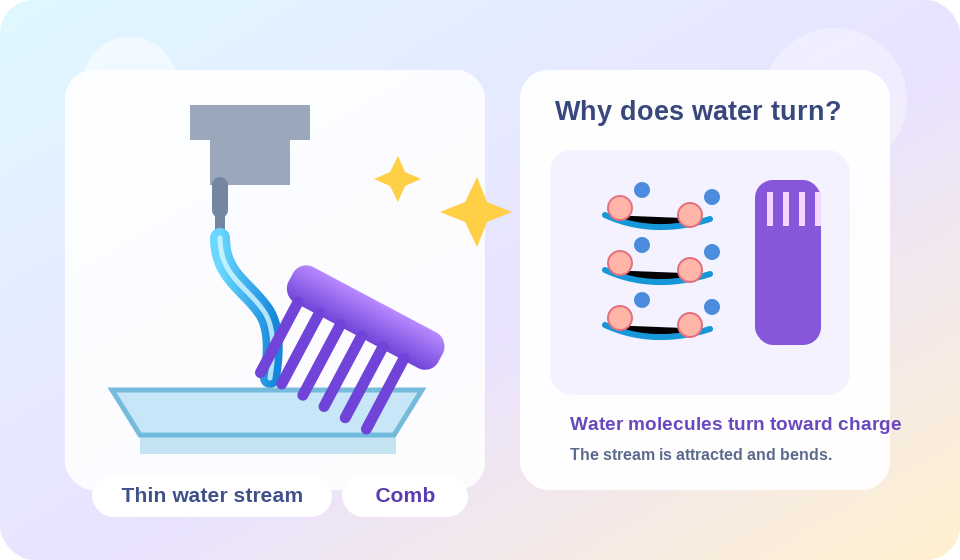
When you rub a dry plastic comb with hair or cloth, electrons can move from one surface to the other. The comb may gain an electric charge. This is called static electricity because the charge is built up on a surface rather than flowing around a circuit.
Water molecules are polar: their electrical charge is distributed unevenly. The electric field around the charged comb makes nearby water molecules turn slightly. The side of each molecule with the opposite partial charge is attracted more strongly, so the narrow stream can curve toward the comb.
Try the demonstration
Ask an adult to make a thin, steady stream of water from a tap.
Rub a clean, dry plastic comb through dry hair or a dry cloth for several seconds.
Bring the comb close to the stream without touching the water. Watch whether the stream bends.
Observe and think: Does the stream move toward the comb? What happens when you move the comb farther away? Try the activity again after rubbing the comb for a different amount of time.
Safety: Keep this activity at a sink, use only a plastic comb and keep water away from electrical appliances, plugs and sockets. An adult should supervise.
A prism separates white light into a visible spectrum.
LIGHT · REFRACTION · DISPERSION
How can a prism make a rainbow?
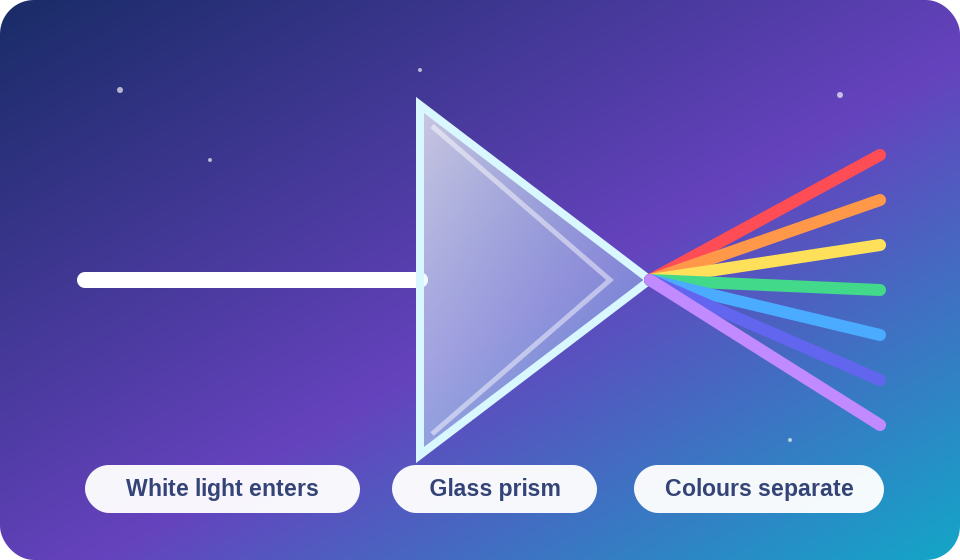
White light is not a single colour. It contains a range of visible wavelengths. When light enters glass from air, its speed changes and its path bends. This bending is called refraction.
Different wavelengths bend by slightly different amounts in glass. When the light leaves the prism, the colours spread apart to form a spectrum. This separation is called dispersion. In a typical glass prism, violet bends more than red.
Explore with a prism
Place a sheet of white paper on a table in a room where you can control the light.
With an adult, shine a white-light torch through a glass or plastic prism toward the paper.
Turn the prism slowly and look for a band of colours on the paper or a nearby white surface.
Observe and think: Which colours can you distinguish? Does rotating the prism change where the colour band appears? Why might a narrow beam make the colours easier to see?
Safety: Never look directly into a torch or at the Sun. Use a cool-running torch and ask an adult to help handle a glass prism.
A good seal lets air pressure help support the card.
AIR PRESSURE · SURFACE TENSION
Why can a card stay under an upside-down cup of water?
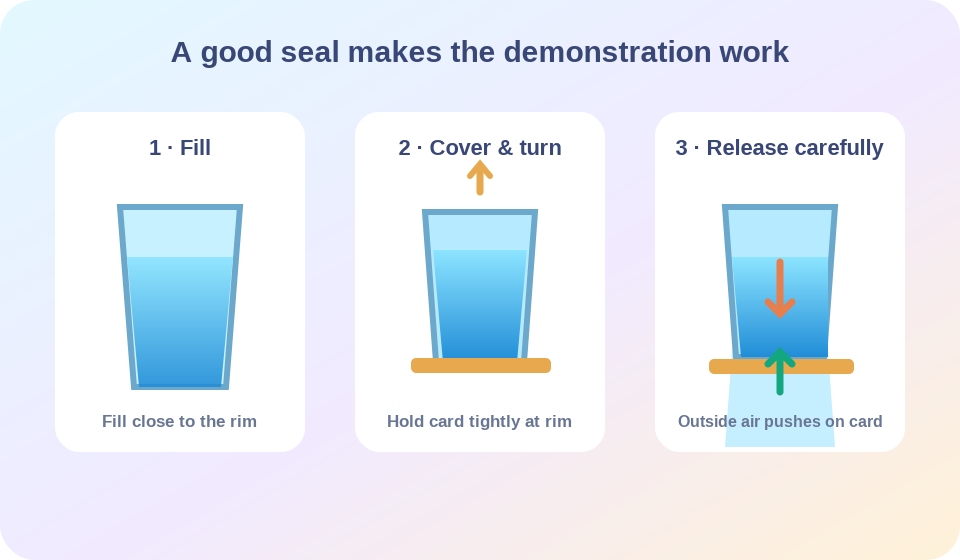
Air may be invisible, but it is made of moving particles. Their collisions create air pressure on surfaces around us. When a cup of water is covered with a stiff card and carefully turned upside down, the air outside pushes against the card. If the rim is well sealed, this pressure helps support the card against the downward force from the water.
Water also helps the seal: water molecules attract one another (cohesion) and can stick to the card and cup (adhesion). Surface tension helps reduce leaks around the edge. The result depends on the seal, the card and the way the cup is turned; it is not a trick that works perfectly every time.
Try the demonstration
Work over a sink or a large tray. Fill a sturdy plastic cup with water.
Place a smooth, stiff card over the opening and hold it firmly against the rim.
With an adult helping, turn the cup upside down while supporting the card. Carefully test whether the card stays in place, keeping it over the sink.
Observe and think: What happens if air slips between the card and the rim? Why is a smooth, well-fitting card important?
Safety: Use a plastic cup, not glass. Keep the experiment over a sink or tray, keep your face away from the cup and have an adult help with the turn.
Connect familiar observations to the scientific ideas behind them. Each explainer includes a way to notice the effect for yourself.
LIGHT · REFRACTION · REFLECTION
Why do we see rainbows?
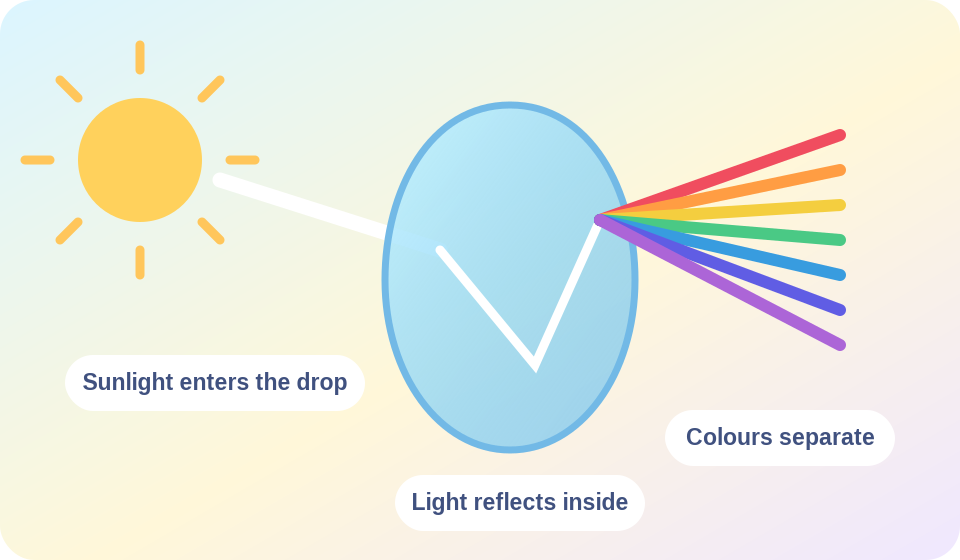
A rainbow appears when sunlight meets water droplets in the air. As light enters each droplet, it changes direction (refraction) and spreads into different colours (dispersion). Some light reflects from the inside of the droplet before bending again as it leaves.
For a primary rainbow, the Sun is usually behind the observer and rain is in front. The rainbow is an optical effect: its exact position depends on where the observer is standing, so you cannot walk to the end of it.
Look for it: After rain, look for a rainbow when the Sun is behind you and rain or spray is ahead. Never look directly at the Sun.
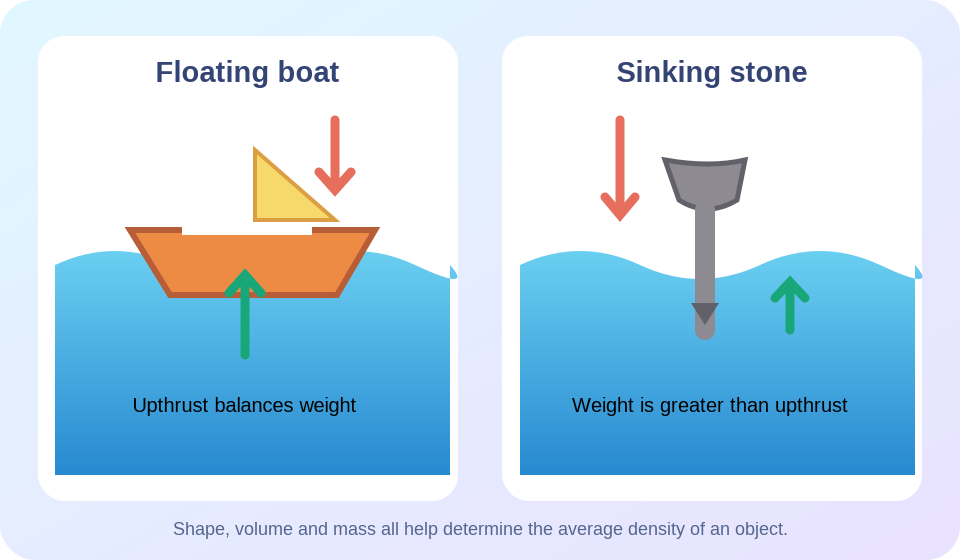
Water pushes upward on objects in it. This upward force is called buoyancy or upthrust. Archimedes’ principle says the buoyant force equals the weight of the fluid an object displaces.
An object floats when the water can provide enough upward force to balance its weight. Its average density matters: a hollow boat contains air and spreads its mass over a large volume, so the boat as a whole can be less dense than water. A small stone is usually denser than water and sinks.
Investigate: With an adult, compare a small piece of modelling clay shaped as a ball with the same clay reshaped into a shallow boat. Predict which shape can support more water before sinking. Use a shallow bowl and dry the area afterwards.
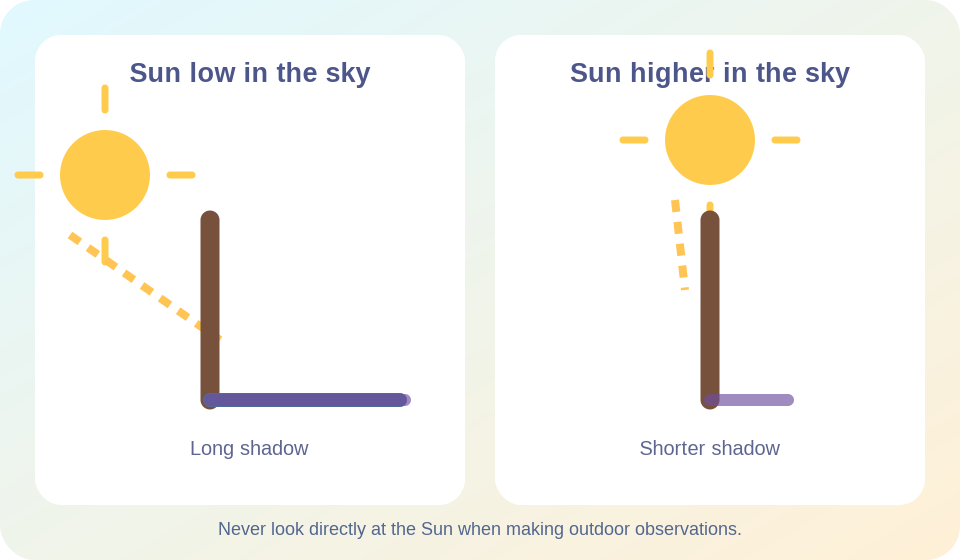
A shadow forms when an opaque object blocks light. During the day, the Sun appears to move across the sky because Earth rotates. When the Sun is low, light arrives at a shallow angle and shadows are longer. When the Sun is higher, shadows are usually shorter.
The direction of a shadow also changes as the Sun's apparent position changes. The exact pattern depends on the time of year and where you are on Earth.
Investigate: Place a stick upright in safe open space. At different times, mark the tip of its shadow and record the time. Compare the length and direction of the marks.
Safety: Never look directly at the Sun. Ask an adult before placing a stick outdoors and choose a safe area away from roads and walkways.
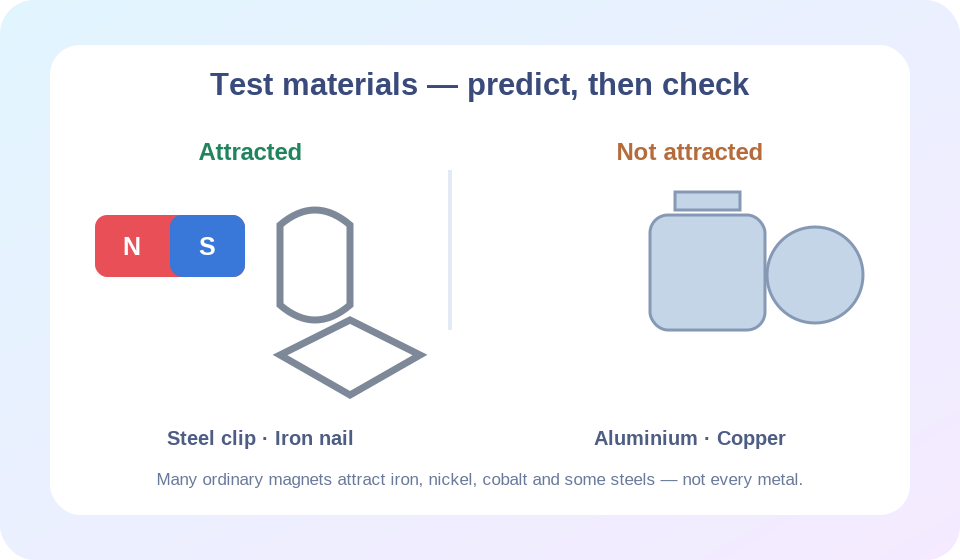
No. A magnet produces a magnetic field, but ordinary classroom magnets attract some materials much more strongly than others. Iron, nickel, cobalt and many types of steel are magnetic. Aluminium and copper are metals, but they are not strongly attracted to an ordinary classroom magnet.
Magnets have north and south poles. Unlike poles attract; like poles repel. Magnetic forces can act without the magnet touching the object.
Investigate: Predict whether a fridge magnet will attract a steel paper clip, aluminium foil, a wooden pencil and a plastic ruler. Test each item and record the material and result.
Safety: Use a large, ordinary classroom or fridge magnet. Keep small or powerful magnets away from young children; swallowed magnets can cause serious internal injuries.
Amazing things living and non-living systems can do
Science helps us understand surprising phenomena. These examples are established scientific explanations; the linked research and education organisations offer more detail.
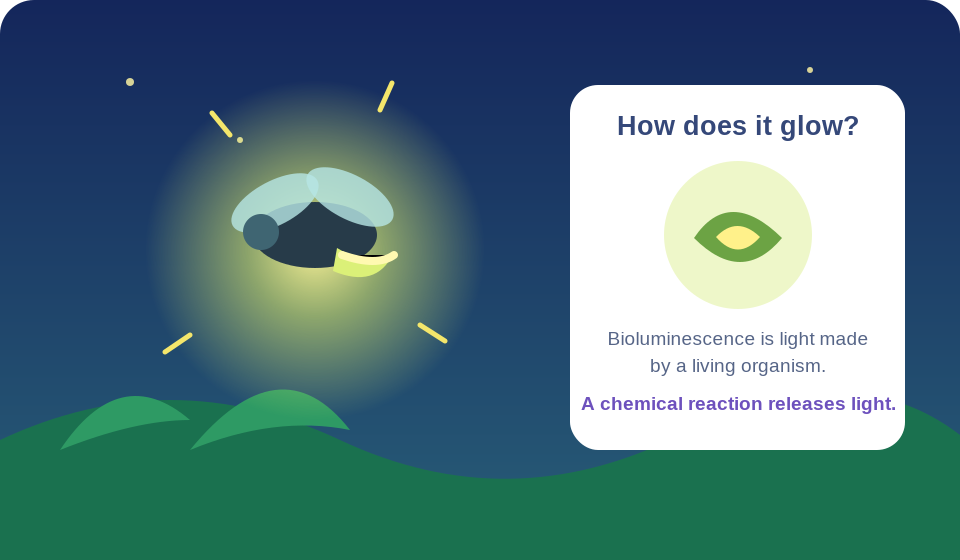
BIOLOGY · CHEMISTRYHow do fireflies make light?
Fireflies use bioluminescence—light produced by a living organism. In many fireflies, a chemical called luciferin reacts with oxygen. An enzyme called luciferase helps the reaction, which releases energy as light. Firefly signals can help the insects communicate.
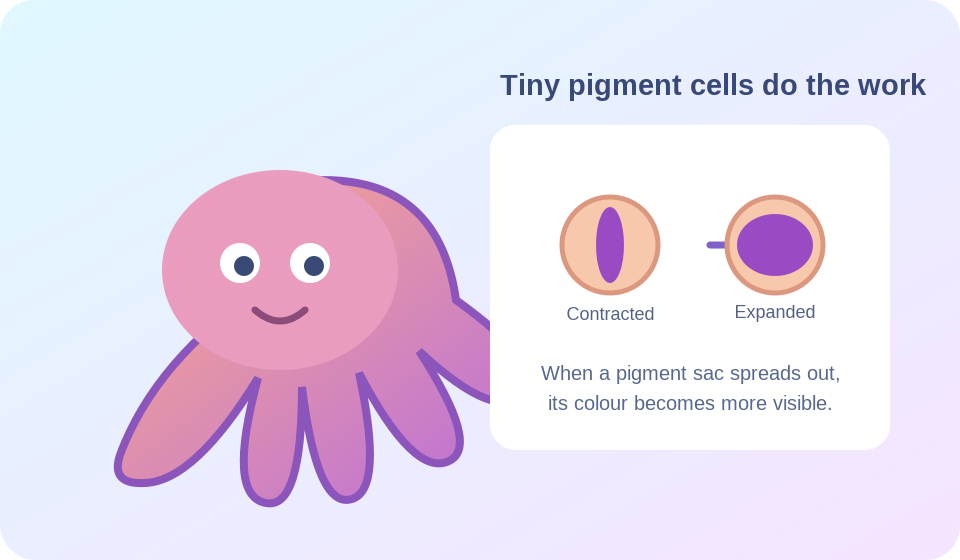
Octopuses have special pigment cells in their skin called chromatophores. Each contains a tiny elastic sac of pigment. Muscles and nerves can expand or contract the sacs, changing how visible the colours appear. Some cephalopods also have reflective cells that create iridescent effects.
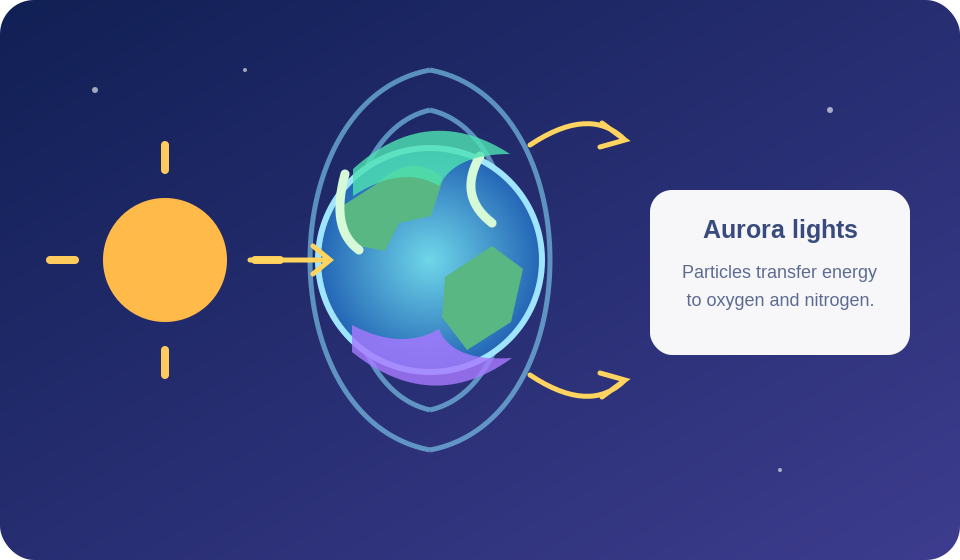
The Sun releases a stream of charged particles called the solar wind. Earth's magnetic environment guides some energy and particles toward the polar atmosphere. There, collisions with oxygen and nitrogen transfer energy to the gases. As the gases release that energy, they produce the colourful lights called auroras.
Learning the words helps you explain what you see and compare your ideas with scientific explanations.
Refraction
The change in direction of light when it passes from one material into another.
Dispersion
The separation of light into its component wavelengths, seen as different colours.
Static electricity
A build-up or imbalance of electric charge on an object's surface.
Air pressure
The force per unit area caused by air particles colliding with a surface.
Buoyancy
The upward force a fluid exerts on an object in the fluid.
Bioluminescence
Light produced by a living organism through a chemical process.
THINK LIKE A SCIENTIST
A simple five-step investigation
A good explanation begins with careful observations. Use these steps for a classroom demonstration or a supervised home activity.
01Ask
Turn your curiosity into a question you can investigate.
02Predict
Write down what you think will happen and why.
03Test
Change one thing at a time and follow the safety instructions.
04Record
Write what actually happened. Separate observations from guesses.
05Explain
Use evidence and science ideas to explain the result. Repeat if needed.
QUICK ANSWERS
Science Hub questions
Are the experiments safe for students?
Each activity includes its own safety note, but demonstrations should be chosen and supervised by a parent, teacher or responsible adult. Use the materials listed, keep water away from electrical equipment, and do not try an experiment if the instructions or risks are unclear.
Do I need special laboratory equipment?
No special laboratory is needed for the demonstrations on this page. They use simple materials such as a plastic comb, a white-light torch, a prism, a plastic cup, a card, a magnet and a shallow container. Ask an adult to help prepare the activity.
How do I know the explanations are reliable?
We provide links to universities, science museums, scientific education organisations and space agencies near the relevant explanations. Use those sources to explore the topic further, and remember that a demonstration is evidence to investigate—not a reason to skip careful thinking.
Can I use these topics for schoolwork?
Yes. Use the explanations to understand the concept, then write your own notes in your own words. For a school investigation, follow your teacher's instructions and record your own observations rather than copying an expected result.
CHECK THE SCIENCE
Sources and further reading
These resources support the explanations on this page. They provide demonstrations, student activities and additional scientific detail.
Page prepared by Kids4U Playhouse for student learning. Scientific explanations are linked to the sources above. Last reviewed: 18 November 2026.
👨👩👧
FOR STUDENTS, PARENTS & TEACHERS
Curiosity grows when you investigate together.
Students can explore the explanations, while parents and teachers help choose suitable activities, supervise demonstrations and talk through the evidence.